Popular Posts
-
Toenail fungus (which is also known as Onychomycosis) is a fungal infection of the toe nails, characterized by discoloration, yellow streaks...
-
Thick 2nd toenail Patient presented to the office complaining of a thick toe nail, happened to be the second toe. She though it mig...
-
Degenerative arthritis is a condition that slowly wears away joints (the link between where bones meet and move). In the beginning, you may ...
Wednesday, May 25, 2011
Wednesday, May 11, 2011
TOP 5 RUNNING INJURIES
Running is a great way to both get and stay healthy. However, without proper precautions, foot and ankle injuries can occur. Today’s podiatrists are uniquely qualified to treat running-related foot and ankle injuries due to their specialized education, training, and experience. Don’t let an injury stop your running routine in its tracks! Look below for the five of the most common foot and ankle-related running injuries.
Plantar Fasciitis
Plantar fasciitis is an inflammation of a fibrous band of tissue in the bottom of the foot that extends from the heel bone to the toes. This tissue can become inflamed for many reasons, most commonly from irritation by placing too much stress (excess running and jumping) on the bottom of the foot.
An ailment that accounts for a large number of running injuries, Achilles tendonitis is an irritation or inflammation of the large tendon in the back of the lower calf that attaches to the back of the heel. The condition is often caused by lack of flexibility and overpronation.
Morton’s Neuroma
Morton’s neuroma is often described by runners as a burning, stinging pain in the forefoot (commonly in the third and fourth toes). Other symptoms include pain in the ball of the foot and a feeling of “pins and needles” and numbness in the toes. Runners who wear tight-fitting footwear often experience this condition. A true neuroma is a benign tumor of the nerve, although entrapment of the nerve will give the same symptoms.
Stress Fracture
Stress fractures in the lower limbs are common among athletes in general, and are commonly caused by repetitive forces on these areas. Symptoms include localized pain and swelling that grows worse over time. Stress fractures can occur over a period of days, weeks, or even months.
Shin Splints
Also referred to as “tibial stress syndrome,” shin splints affect runners of all ages and are commonly experienced as a shooting pain felt near the front or sides of one or both tibia bones (the shins).
Monday, May 9, 2011
YOUR CHILD'S FLAT FEET
Flat feet is a condition in which the foot doesn't have a normal arch. It may affect one foot or both feet. At first, all babies' feet look flat because an arch hasn't formed yet. Arches should form by the time your child is 2 or 3 years old.
What causes flat feet?
Most flat feet are caused by loose joint connections and baby fat between the foot bones. These conditions make the arch fall when your child stands up. This is why you sometimes hear flat feet called "fallen arches." The feet may look like they have arches when your child is sitting or when the big toe is bent backward, but the arch flattens when the child puts weight on the foot.
Should I take my child to the doctor?
If your child complains of foot or ankle pain, take him or her to the doctor. Flat feet in an older child may cause pain in the heel or arch, or may cause pain when the child is walking and running. Your doctor will look at your child's feet to make sure that the pain isn't caused by a problem in the hip or the knee. Rarely, flat feet can be caused by foot bones that are joined together. In this case, the bones can't move, and the foot hurts. Your child may need to have x-rays, but your doctor probably can tell you what the problem is just by looking at your child's feet.
Monday, May 2, 2011
RUNNING INJURIES
What causes an overuse injury in a runner?
Overuse injury in a runner most often occurs because of a training error (running too far, too fast, too soon). With every mile that is run, the feet must absorb 110 tons of energy. Therefore, it is not surprising that up to 70% of runners develop injuries every year. How can overuse injury be prevented?
You can decrease your risk of injury by following these recommendations:
· Do not increase running mileage by more than 10% per week.
· Do not run more than 45 miles per week. There is little evidence that running more than 45 miles per week improves your performance, but a great deal of evidence shows that running more than 45 miles per week increases your risk for an overuse injury.
· Do not run on slanted or uneven surfaces. The best running surface is soft, flat terrain.
· Do not "run through pain." Pain is a sign that should not be ignored, because it indicates that something is wrong.
· If you do have pain when you run, place ice on the area and rest for 2 or 3 days. If the pain continues for 1 week, see your doctor.
· Follow hard training or running days with easy days.
· Change your running shoes every 500 miles. After this distance shoes lose their ability to absorb the shock of running.
What about orthotics to reduce the chance of injury?
Orthotics are inserts that are placed in shoes to correct bad alignment between the foot and the lower leg. You will probably need orthotics if the inside of your foot turns in, a problem called pronation. Your doctor may suggest orthotics if you have bad alignment and become injured and do not get better with other measures, such as rest, ice application and cross training.
Wednesday, April 27, 2011
HIGH BLOOD PRESSURE
As a member of the health care team, your Podiatrist is vitally concerned about hypertension and vascular disease. Your Podiatrist should know if you have any of the following cardiovascular or related conditions:
- Hypertension and/or cardiovascular disease:
- Hypertension sometimes causes decreased circulation. A careful examination is required to determine if there is lower than normal temperature in any of the extremities, absence of normal skin color, or diminished pulse in the feet.
- Rheumatic Heart Disease:
- Persons who have had rheumatic heart disease must be protected with prophylactic antibiotics prior to any surgical intervention.
- Diabetes:
- This condition frequently affects the smaller arteries, resulting in diminished circulation and decreased sensation in the extremities.
- Ulceration:
- Open sores that do not heal, or heal very slowly, may be symptoms of certain anemias, including sickle cell disease; they may also be due to hypertension or certain inflammatory conditions of the blood vessels.
- Swollen feet:
- Persistent swelling of one or both feet may be due to kidney, heart, or circulatory problems.
- Burning feet:
- Although it can have a number of causes, a burning sensation of the feet is frequently caused by diminished circulation.
Monday, April 25, 2011
DIABETIC FOOT CARE
Diabetes is a chronic disease that affects the lives of about 20.8 million people in the United States, 6.2 million of whom are unaware that they even have the disease. Every day, 2,200 new cases of diabetes are diagnosed, and an estimated 1.5 million new cases are identified each year.
If you already have diabetes:
- Wash feet daily
- Inspect feet and toes daily
- Lose weight
- Wear thick, soft socks
- Stop smoking
- Cut toenails straight across
- Exercise
- See your Podiatric Physician
- Be properly measured and fitted every time you buy new shoes
- Don't wear high heels, sandals, and shoes with pointed toes
- Don't drink in excess
- Don't wear anything that is too tight around the legs
- Never try to remove calluses, corns, or warts by yourself
The Role of Your Podiatric Physician
Your Podiatrist is trained to look for the following warning signs (that you should look for as well):
- Skin color change
- Elevation in skin temperature
- Swelling of the foot or ankle
- Pain in the legs
- Open sores on the feet that are slow to heal
- Ingrown and fungal toenails
- Bleeding corns and calluses
- Dry cracks in the skin, especially around the heel
Monday, April 18, 2011
CRACKS AND FISSURES
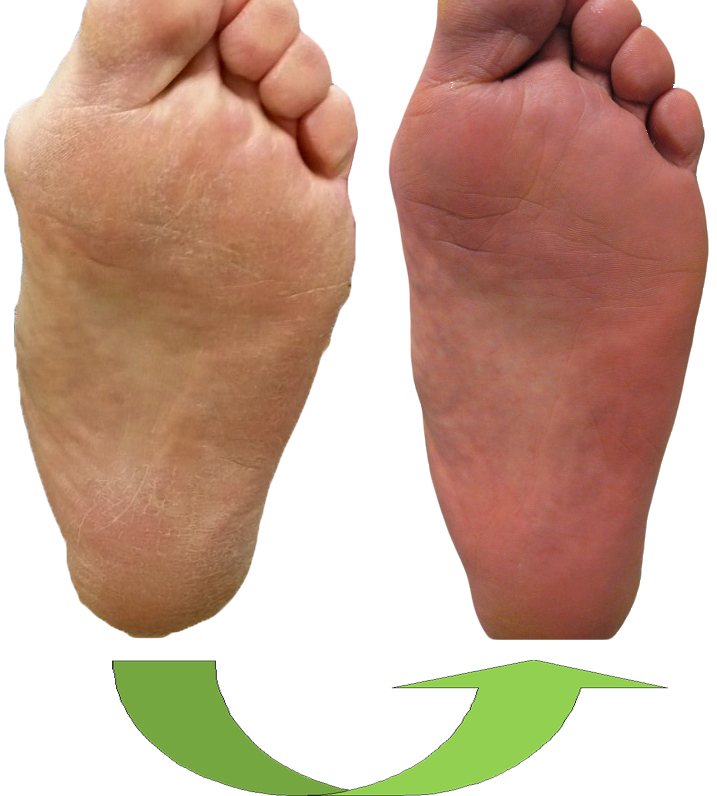
Cracks and fissures are breaks in your skin. They may be the result of skin that is too dry or too moist. When skin is too dry, it can become rough and flaky. A large fissure often forms at the base of the heel. When skin is too moist, you may get a bacterial or fungal infection. This can cause cracks between the toes.
When Skin Is Too Dry
- Walking barefoot can strip your skin of its natural oil; so can wearing sandals or open shoes
- Without enough natural oils to form a protective layer on your skin, your skin may crack
- Cracks may widen, becoming deep fissures; these fissures may not be able to heal on their own
When Skin Is Too Moist
- Moist skin can result from not drying feet after bathing or from excess sweat
- Wearing shoes without socks or shoes and socks that don't ventilate can trap sweat on your feet
- Overly moist skin can encourage bacteria and fungus to grow; this weakens your skin, leading to cracks
Caring For Dry Skin
- Use moisturizer on your feet after bathing and at bedtime
- Ask your doctor before using a pumice stone to reduce calluses
- Never walk barefoot; avoid sandals and other open shoes
- Always dry feet between your toes after bathing; don't apply moisturizer between toes
- Ask your doctor about using anti-fungal powders and lotions or special foot anti-perspirants
- Choose cotton socks instead of nylon
Remember to check your feet daily!
Wednesday, April 13, 2011
WHAT IS PERIPHERAL NEUROPATHY?
Peripheral neuropathy is a disease that can damage nerves in the feet and prevent them from working properly. It's most common in people with diabetes. Neuropathy can also be caused by poor nutrition, injury, and other diseases. When nerves are damaged, you may have changes in sensation, including numbness. Not being able to sense pain makes you more likely to injure your feet without knowing it. Over time, neuropathy can lead to permanent loss of nerve function, as well as bone and joint damage.
Common Symptoms
Common Symptoms
- Numbness
- Burning or pain
- Tingling, or a feeling of "pins and needles"
- Feeling like you're wearing an invisible sock
Treating Peripheral Neuropathy
- Eating foods high in vitamin B can help improve nerve problems caused by poor nutrition. In some cases, vitamin supplements may be needed.
- Gentle exercises, like walking or riding a stationary bicycle, are best. Daily exercise improves blood flow in your feet. In also increases foot strength and flexibility.
Wednesday, April 6, 2011
WHAT IS ARTHRITIS?
Degenerative arthritis is a condition that slowly wears away joints (the link between where bones meet and move). In the beginning, you may notice that the affected joint seems stiff and it may even ache. As the joint lining (cartilage) breaks down, the bones rub against each other, causing pain or swelling.
The Big-Toe Joint
When arthritis affects your big toe, your foot hurts when it pushes off the ground. Arthritis often appears in the big-toe joint along with a bunion.
Other Joints
When arthritis affects the rear or midfoot joints, you feel pain when you put weight on your foot. Arthritis may affect the joint where the ankle and foot meet. It may also affect other joints nearby.
Treating Arthritis
The Big-Toe Joint
When arthritis affects your big toe, your foot hurts when it pushes off the ground. Arthritis often appears in the big-toe joint along with a bunion.
Other Joints
When arthritis affects the rear or midfoot joints, you feel pain when you put weight on your foot. Arthritis may affect the joint where the ankle and foot meet. It may also affect other joints nearby.
Treating Arthritis
- Medications
- Your doctor may prescribe medication to limit pain and swelling. Ice, aspirin, or ibuprofen may help relieve mild symptoms that occur after activity.
- Trimming Bone
- If the bone is not damaged too badly, your doctor may simply shave away bone spurs. Any excess bone growth related to a bunion may also be trimmed.
- Fusing Joints
- If damage is more severe, your doctor may fuse the joint to prevent the bones from rubbing. Afterward, staples or screws may hold the bones in place so they heal properly. In some cases, the joint may be removed and replaced with an implant.
An example of joint fusing of a patient with rheumatoid arthritis.
Monday, April 4, 2011
TIPS FOR BUYING SHOES
From ancient Egyptian times down through the centuries, footwear has been designed to meet mankind's real and perceived needs: protection, support, comfort, sturdiness, and stylishness. Here are some tips to help you buy the right shoes:
- Have your feet measured while standing up
- Always try on both shoes, and walk around the store
- Always buy for the larger foot; feet are seldom precisely the same size
- Don't buy shoes that need a "break-in" period; shoes should be comfortable immediately
- Don't rely on the size of your last pair of shoes. Your feet do get larger!
- Shop for shoes later in the day; feet tend to swell during the day, and it's best to be fitted while they are in that state
- Be sure that shoes fit well (front, back, and sides) to distribute weight. It sounds elementary, but be sure the widest part of your foot corresponds to the widest part of the shoe
- Select a shoe with a leather upper, stiff heel counter, appropriate cushioning, and flexibility at the ball of the foot
- Buy shoes that don't pinch your toes, either at the tips, or across the toe box
- Try on shoes while you're wearing the same type of socks or stockings you expect to wear with the shoes
- If you wear prescription orthotics you should take them along to shoe fittings
For longer service, keep shoes clean and in good repair. Avoid excessive wear on heels and soles. Give your shoes a chance to breathe, don't wear the same pair two days in a row. Follow these steps to good care of your shoes!
Monday, March 28, 2011
WHAT IS A NEUROMA?
A neuroma is a painful growth of nerve tissue in the foot - most often between the third and fourth toe bones. It forms when bones in the feet press together and irritate a nerve. This may be caused by wearing tight or poorly fitting shoes, or by repeated stress on the foot. Neuromas often form in women who wear high heels frequently. Injury or a foot deformity can also cause a neuroma.
Here are some symptoms of a neuroma:
- A sharp, burning pain in the ball of the foot, especially when walking.
- Tingling or numbness between the toes and the ball of the foot.
- A feeling that you have a stone in your shoe, or that your sock is wrinkled.
- A painful lump that reproduces your symptoms when touched.
As a neuroma gets worse, it can cause a lot of pain and keep you from activities you enjoy. Fortunately, there are several ways to reduce symptoms, such as:
- Shoe changes and orthotics
- Padding and taping
- Physical Therapy
- Medication
Your doctor will talk with you about possible treatments. In most cases, painful symptoms can be reduced without surgery. For severe problems, your doctor may recommend treating the nerve directly. Left untreated, neuromas often get worse.
Wednesday, March 23, 2011
WHAT IS TENDONITIS?
When you use a set of muscles too much, you're likely to strain the tendons (soft tissues) that connect those muscles to your bones. At first, pain or swelling may come and go quickly. But if you do too much too soon, your muscles may overtire again. The strain causes the tendon's outer covering to swell or small fibers in a tendon to pull apart. If you keep pushing your muscles, damage to the tendons adds up and tendonitis develops.
X-rays may be taken to rule out a broken bone. To identify damage to a tendon, your doctor may order an MRI.
To treat tendonitis, you can try:
X-rays may be taken to rule out a broken bone. To identify damage to a tendon, your doctor may order an MRI.
To treat tendonitis, you can try:
- Ice and heat
- Ice helps to prevent swelling while heat helps to reduce it
- Medications
- Aspirin or other anit-inflammatory medications may help to reduce pain and swelling
- Limiting Activities
- Rest allows the tissues in your foot to heal
Monday, March 21, 2011
HAMMERTOES
What Is A Hammertoe?
A hammertoe is a contracture-or bending-of the toe at the first joint of the digit, called the proximal interphalangeal joint. This bending causes the toes to appear like an upside-down V when looked at from the side.
How Do You Get A Hammertoe?
A hammertoe is formed due to an abnormal balance of the muscles in the toes. This abnormal balance causes increased pressures on the tendons and joints of the toe, leading to a contracture. Heredity and trauma can also lead to the formation of a hammertoe.
What Can You Do For Relief?
A hammertoe is a contracture-or bending-of the toe at the first joint of the digit, called the proximal interphalangeal joint. This bending causes the toes to appear like an upside-down V when looked at from the side.
How Do You Get A Hammertoe?
A hammertoe is formed due to an abnormal balance of the muscles in the toes. This abnormal balance causes increased pressures on the tendons and joints of the toe, leading to a contracture. Heredity and trauma can also lead to the formation of a hammertoe.
What Can You Do For Relief?
- Apply a non-medicated hammertoe pad around the bony prominence of the hammertoe
- Wear a shoe with a deep toe box
- If it becomes inflamed and painful, apply ice packs several times a day to reduce swelling
- Avoid heels more than two inches tall
- Avoid wearing shoes that are too tight or too narrow
Remember that foot pain is not normal. Healthy, pain-free feet are a key to your independence and need regular attention.
Friday, March 18, 2011
Wednesday, March 16, 2011
HIGH HEELS
Did you know that high heels may contribute to knee and back problems? If women persist in wearing high heels, there are ways to relieve some of the abusive effects:
- They can limit the time they wear them
- Alternating high heels with good-quality oxford-type shoes or flats for part of the day
- Buy shoes in the afternoon to prevent tight shoes, since feet tend to increase in size later in day
- See your podiatrist for a custom made pair of orthotics for your high heels
Monday, March 14, 2011
ON-THE-JOB FOOT HEALTH
Your ability to use your feet safely, with ease and comfort, is vital if you are to remain a valuable and productive worker. When your job requires you to walk significant distances, stand on your feet for long periods, work in potentially hazardous areas or with potentially hazardous materials, you have some risk of foot injury. However, you can do a lot to prevent injuries by keeping your feet healthy and following these safe work practices:
- Be aware of the hazards of your job and the proper protective measures to take.
- Don't take chances or unnecessary risks. Take time to do your job right.
- Be alert. Watch for hidden hazards.
- Be considerate. Watch out for other worker's safety.
- Follow the rules. Don't cut corners. Use your equipment as specified.
- Concentrate on the job. Inattention can lead to accidents.
- Pace yourself. Work steadily at a comfortable speed.
- Keep your work area clean and your tools in their place.
Keeping these tips in mind, enjoy your Monday!
Friday, March 11, 2011
DRY FEET - BATHING
Did you know that excessive bathing will sometimes dry out the skin of the feet? When bathing, we are removing a layer of the body's natural oils that it may need to retain the moisture of the skin. Although bathing is necessary for cleanliness and reduction of harmful bacteria, it can also be taken to the extreme and create a harmful effect.
Wednesday, March 9, 2011
TIPS FOR PREVENTION OF FUNGAL NAILS
- Proper hygiene and regular inspection of the feet and toes are the first lines of defense against fungal nails
- Clean and dry feet resist disease
- Washing the feet with soap and water, remembering to dry thoroughly, is the best way to prevent an infection
- Shower shoes should be worn when possible in public areas
- Shoes, socks, or hosiery should be changed more than once daily
- Toenails should be clipped straight across so that the nail does not extend beyond the tip of the toe
- Wear shoes that fit well and are made of materials that breathe
- Avoid wearing excessively tight hosiery, which promote moisture
- Socks made of synthetic fiber tend to "wick" away moisture faster than cotton or wool socks
- Disinfect instruments used to cut nails
- Disinfect home pedicure tools
- Don't apply polish to nails suspected of infection - those that are red, discolored, or swollen, for example
- AND, See Your Podiatrist!
Monday, March 7, 2011
INGROWN TOENAILS
Ingrown toenails may be caused by:
- Improperly trimmed nails (Trim them straight across, not longer than the tip of the toes. Do not round of corners. Use toenail clippers.)
- Heredity
- Shoe pressure; crowding of toes
- Repeated trauma to the feet from normal activities
If you suspect an infection due to an ingrown toenail, see your podiatrist. "Do-it-yourself" treatments, including any attempt to remove any part of an infected nail or the use of over-the-counter medications, should be avoided. Nail problems should be evaluated and treated by your podiatrist, who can diagnose the ailment, and then prescribe medication or another appropriate treatment.
A podiatrist will resect the ingrown portion of the nail and may prescribe a topical or oral medication to treat the infection. If ingrown nails are a chronic problem, your podiatrist can perform a procedure to permanently prevent ingrown nails. The corner of the nail that ingrows, along with the matrix or root of the piece of nail, are removed by use of a chemical, a laser, or by other methods.
Thanks to the APMA for the information.
Friday, March 4, 2011
SELF ASSESSMENT OF YOUR FEET - WHEN TO SEE A PODIATRIST
Every local drugstore has aisles of “do-it-yourself” medical fixes. For your feet they have blister and corn pads, insoles, fungus sprays, and nail clippers. So when you have foot and ankle problems, how do you know
when to deal with them at home using over-the-counter (OTC) products and when to see the podiatrist?
should always opt to visit the podiatrist for even minor concerns. People who do not have diabetes or PVD should also be wary of pain, color changes, drainage, swelling, heat, or open areas in or on any part of the foot or ankle. These signs warrant a professional’s experience in dealing your the problem.
when to deal with them at home using over-the-counter (OTC) products and when to see the podiatrist?
- If you suspect that you have an ingrown nail, it is best not to use OTC products. See your podiatrist as soon as possible to avoid the possibility of infection. The doctor can safely remove the ingrown nail and may be able to alleviate the problem entirely for the future.
- OTC wart removal medication is relatively mild but can cause ulcerations if left on too long. You can try to alleviate warts on the feet with these products, but the podiatrist has more effective medications and can also do simple procedures to rid you of warts. Wart removers should never be used if you have neuropathy except under the supervision of a podiatric physician.
- Despite numerous blogs and articles about treating onychomycosis (fungal nails) and warts with Vick's VapoRub, duct tape, bleach, white vinegar, and other household items, there are no scientific data or evidenced-based research studies to support these treatment options.
- Sprains and strains can be treated at home initially with the “RICE treatment” - rest, ice, compression, and elevation. If swelling is persistent, a visit to the podiatrist’s office is in order to determine if there are any broken bones.
should always opt to visit the podiatrist for even minor concerns. People who do not have diabetes or PVD should also be wary of pain, color changes, drainage, swelling, heat, or open areas in or on any part of the foot or ankle. These signs warrant a professional’s experience in dealing your the problem.
Subscribe to:
Posts (Atom)